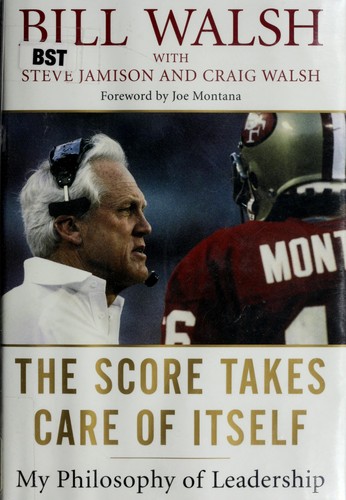
The Score Takes Care of Itself
Sports & CoachingLeadership, Business & MoneySelected Passages
Selected passages
Bill didn’t jump on you for a mistake; he came right in with the correction: “Here’s what was wrong; this is how to do it right.” Over and over, without getting all upset, he taught the smallest details of perfecting performance.
The dictates of your personal beliefs should ultimately become characteristics of your team.
I focused our personnel on the details of my Standard of Performance—trying to achieve it—rather than how we measured up against a given team (i.e., the score). “Let the opponent worry about that” was my thinking
By focusing strictly on my Standard of Performance, the 49ers were able to play the bigger games very well because it was basically business as usual—no “try harder” mentality was used. In fact, I believed it would be counterproductive. I might do even less strategizing for a Super Bowl game, because in the midst of the extreme pressure I placed a premium on fundamentals, the skills and the execution ability the team already possessed as a result of our concentration and hard work going all the way back to day one of training camp
Success doesn’t care which road you take to get to its doorstep.
Our first twenty or twenty-five plays of the game would be scripted, along with a multitude of options, alternatives, and contingency plays depending on the situation and circumstance. ... Scripting was a preprepared format, a flexible blueprint
In my years as a head coach, I wanted a democratic-style organization with input and communication and freedom of expression, even opinions that were at great variance with my ideas. But only up to a point. When it was time for a decision, that decision would be made by me according to dictates having to do with one thing only, namely, making the team better. And once the decision was made, the discussion was over. My ultimate job, and yours, is not to give an opinion. Everybody’s got an opinion. Leaders are paid to make a decision.
a leader needs a very hard edge inside; it has to lurk in there somewhere and come out on occasion. You must be able to make and carry out harsh and, at times, ruthless decisions in a manner that is fast, firm, and fair. Applied correctly, this hard edge will not only solve the immediate difficulty, but also prevent future problems by sending out this important message: Cross my line and you can expect severe consequences.
I could be very cutting, very sharp in criticizing a player or coach, but I always made an effort to counter it by following up the barbs with more upbeat input immediately afterward. I avoided creating a chain of negatives. ... My praise was sparse, but meaningful because it was rarely effusive
Communication means people will disagree—strongly at times—but they must understand that disagreement should not fester. “Get a cup of coffee, put your arm around the shoulder of the person you’re bumping heads with, and say, ‘Let’s talk about this,’ ” was my directive. “You’re not always right, nor is the other person. Sometimes you’re both wrong. Sometimes there are three sides to a coin.”
Change is inevitable, but change is not a casual consideration.
We may lose this afternoon, and if we do, I can live with it. This is only a football game. However, if we go down, you must decide how you want it to happen.Frankly, I care a lot more about how we lose than if we lose
having the courage to say, “I believe in you,” in whatever words and way are comfortable for you. These four words—or their equivalents—constitute the most inspirational message a leader can convey.
And always keep this in mind: Nobody will ever come back to you later and say “thank you” for expecting too little of them.
If you care about how you’re perceived by others, including the public, it’s good to remember the following: Criticism—both deserved and undeserved—is part of the territory when you’re the one calling the shots. Ignore the undeserved; learn from the deserved; lick your wounds and move on.
Calculated risks are part of what you do, but the idea that something completely crazy will work just because it’s completely crazy is completely crazy. It fails dramatically more often than it succeeds, but when it does succeed you’re tempted to do it again, and that’s when you get caught